
What you will learn in the manual
What an organizational structure is and what it is used for – breakdown of companies, branches, departments and groups of persons, use for filtering in lists and integration with the HR system.
How to manage and use individual types of structures – required data, superior level, archiving of inactive persons, agency structures for external employees and activation for capacity planning.
What is an organizational structure?
An important item from the perspective of segmentation – into companies, branches, departments, groups of persons and others. It is used, for example, for filtering in lists throughout the entire application (Persons agenda, Attendance overview/Attendance, Projects, etc.).
The division of organizational structures can, where applicable, be identical to the HR system and, for example, used for automatic synchronization of persons from the HR/information system Aktion.eNEXT.
Basic data
The basic screen of the detail window of the Organizational Structure agenda. For a new organizational structure, it is necessary to fill in the required data; without these parameters it is not possible to save the record. Required parameters are always highlighted with “*” (the specific required parameters may differ based on the particular application settings – Application Configuration – Column settings – Require).
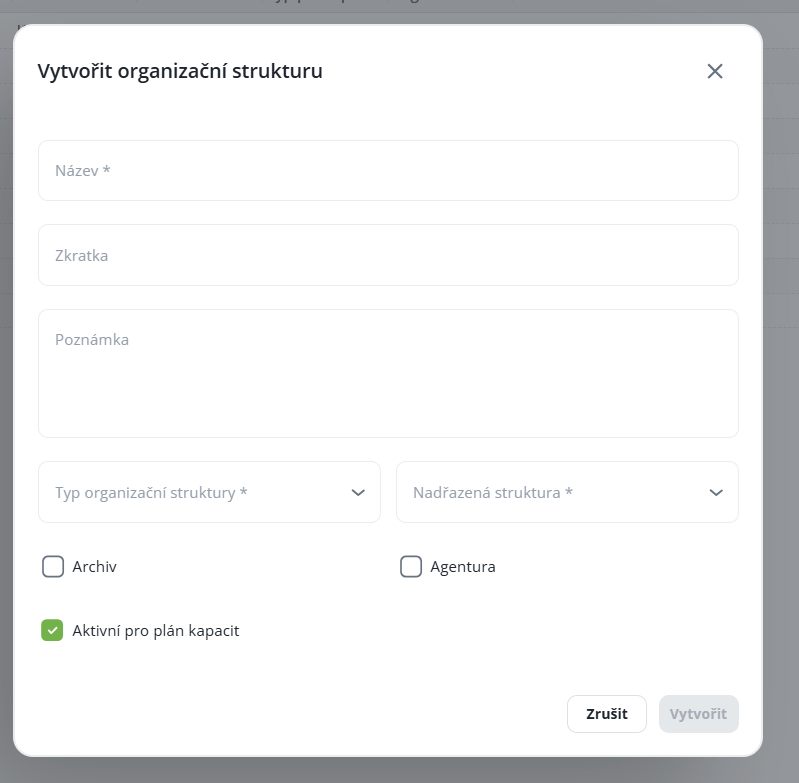
Parent level – when creating a new organizational structure, in addition to the name it is necessary to fill in the Parent level field. The highest structure (root) is always preset.
Type – mandatory, the type of the currently created part of the organizational structure is selected, e.g. in this case Company. The type of organizational structure is created in the agenda Types of organizational structures.
Archive – ensures that the given persons will not be displayed by default in the selection in the Persons agenda. It serves as an archival structure for inactive records.
Agency – Creates an agency structure from the structure, suitable for capacity planning. Persons in this structure are marked with the abbreviation of the structure and it is typically used, for example, for external employees.
Active for capacity planning – Activates the structure for capacity planning so that persons from this structure will be displayed and offered during planning.